If you don’t understand your Body Proportions you might be feeling out of balance. Ask yourself these questions:
Are some areas of your body seem longer and others seem shorter when you look in the mirror?
Feel like some clothes emphasizes the longer and/or the shorter areas?
Do you feel out of balance when wearing these clothes?
Have you ever wondered how to visually shorten one area and lengthen another?
Keep reading and you will learn how to create balance.
Developing Body Proportions Element
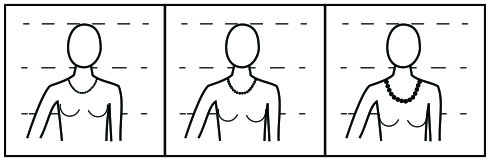
When developing my five body element system, I talked to a lot of stylists to discover their thought processes when dressing a woman. One of them told me she looks at the space between body areas, for example, between the chin and bust the larger the space the larger the necklaces or the smaller the space the smaller the necklaces.
I found this idea interesting and it made perfect sense to me. As a result, I began exploring other body proportion clues which lead me to the placement of horizontal lines.
As you learned in Horizontal Lines: Friend or Foe, horizontal lines visually shorten an area.
In my experience, many women possess little space between their busts and waists. I also saw many of these same women with a longer space between their waists and crotch areas (much easier to carry and birth babies).
Why Most Waistband Are Below The Natural Waist
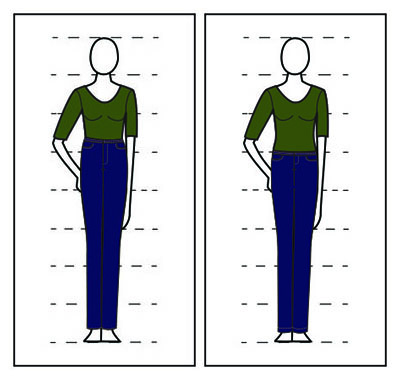
In time more and more women adopted the trend of lower waistband pants. Why? Because these women instinctively knew a waistband below their natural high waists looked better because it created more visual space between the bust and waistband.
On the other hand, those women with a long waist to crotch area put the waistband below their waists which visually shortens this area.
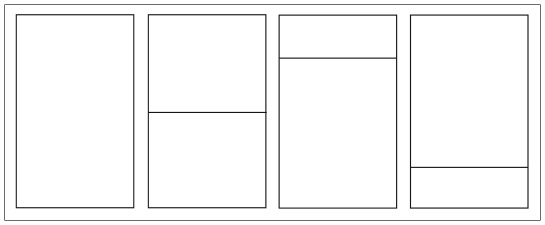
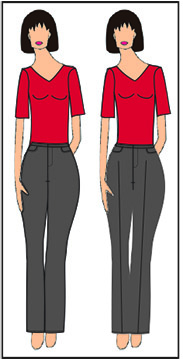
In time the waistband height stabilized at or just below the belly button (it is 1 to 2 inches below the natural waist). This horizontal line visually lengthens the space between the bust and waist. It also visually shortens the space between the waist and crotch.
In the beginning of my research I found a book about body proportion in art. This book stated that an 8 head tall body creates the best balanced body. Further research confirmed this statement.
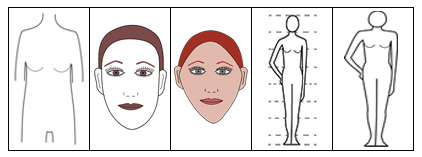
As a result of putting all this information together I created the fourth body element “Body Proportion.” This body element gives you clues about the:
Horizontal line placement
Vertical line placement
Scale of accessories and prints that lie within each body area
In this post you will learn:
How to determine your body proportions
Placement of horizontal and vertical lines
Scale of accessories and prints
Determine Your Body Proportions
You determine your body proportions by getting out a tape measure and measuring each area. Once I understood my body proportions, I really started to understand why certain clothes worked for me and others didn’t.
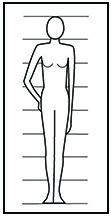
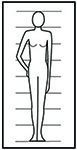
To understand your body proportion compare your actual length to an idealized length. The idealized length is:
Top of head to chin – 1 head
Chin and bust – 1 head
Bust and natural waist – 1 head
Natural waist and crotch – 1 head
Crotch and knees – 2 heads
Knees and floor – 2 heads
To determine your idealized length you divide your height by the length of your head.
Tools you need:
Wall or door that marks can wash off easily
Pencil (I find pencil marks can wash off easily)
Yardstick or long measuring tape to measure your areas
Paper to write down your results
Steps In Determining Body Proportions
Steps to determine body proportions:
Lean up against a door or wall
Make a mark for height
Mark under the chin
Draw a mark at the nipple level (if possible make sure “the girls” look straight out because that creates a better measurement)
Make a mark at the natural waist (when bending to the side your natural waist is that bending point)
Draw a crotch mark
Mark at the knees
Measure your total height and between each area and make a note of your measurements
Divide your total height by 8 (this gives you your ideal head length for your height) and make a note of this length
Compare your actual length to the ideal length for each area
If the actual length is shorter than the ideal length then you’re considered short in this area
If the actual length is longer than the ideal length then you’re considered long in this area
Make a note if you are long, short or same in each area
In the first body element Body Shape, you figured out the placement of horizontal and vertical lines to create balance within your body silhouette. Go to What Are Your Body Shape Clues? to review Body Shape and the placement of horizontal and vertical lines.
Now that you understand your body proportions you can more precisely understand the placement of horizontal and vertical lines within each body area.
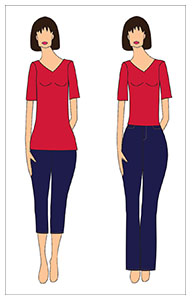
Do you have short areas? Avoid horizontal lines at all cost. Putting them in this area causes the area to appear even shorter. Instead place vertical lines in this area to elongate it. Another strategy is to place a horizontal line in the area above or below as shown in lowering the pant waistband.
I’m short between the knees and the floor so I avoid capris. When I wear them my legs appear much shorter than my torso causing my body to be out of balance.
Do you have long areas? Place your horizontal lines in these areas because they will help this area appear more balanced.
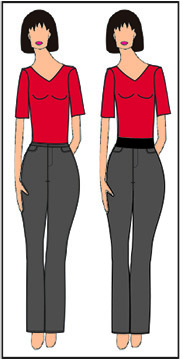
I wear a lot of wide belts and whenever I wear them I always get a lot of compliments. The belt creates a horizontal line between my bust and waist causing my torso to be more in balance with my legs.
Placement of Vertical Lines
With respect to vertical lines, place them in short areas. By doing this these areas appear longer.
Even before I knew my legs are shorter than my torso, I always wore my trousers with a center crease. This center crease acts like a vertical line creating length in my legs.
Go To Closet
Go to your closet and put on that outfit you love to wear. Note the horizontal line and vertical line placement. Ask yourself the following questions:
Are there horizontal lines in your short areas?
Do horizontal lines land in areas that are same or long?
In your short areas, do you find vertical lines?
Does this outfit create an overall balanced look?
Note the placement of horizontal and vertical lines. This is your guide when buying future clothes.
Now put on outfits you don’t wear very often and look at the horizontal line placement. There are three reasons why you don’t like wearing them:
Horizontal line placement
Vertical line placement
Second scale clue
Poor horizontal line placement creates the feeling of being out of balance.
Scale -- Second Clue
Body proportion gives you the second of three scale clues. This clue tells you the scale of prints and accessories in a particular area. For example, the length between your chin and bust affects the scale of your necklace.
The overall scale increases or decreases depending if you’re short or long in a particular area:
Short body proportion — scale decreases
Long body proportion — scale increases
If you are short between your chin and bust, you decrease the size of your necklace. On the other hand being long between your chin and bust, you increase the size of your necklace.
Go back to your notes above and add further notes to decrease scale in short areas and increase scale in long areas. Save this information for the post on bringing all three scale clues together.
Now you understand the clues your body proportions give you:
Placement of horizontal lines
Placement of vertical lines
Second scale clue
Just understanding the placement of horizontal lines will go a long way in creating a closet full of clothes you love to wear.
Did you have any “ah ha” moments, like I did, when understanding your body proportions? Share your “ah ha” moment in the comments below.
The next post will be the last body element: Body Frame Size.
2 thoughts on “Body Proportions — Out Of Balance?”
Tracy S Oliver
Hi Joy, Here is what I got:
Body Proportion:
Head to Chin: Short 7 1/2
Chin to Nipple: Short 8 1/2
Nipple to Waist: Short 7 1/2
Waist to Crotch: Long 10
Crotch to Knee: Long 10 1/2
Closet:
Dress pants with crease down the front-no pockets on front
Dress pants free flowing with no crease, straight vertical lines
Jeans: all fit lousy. Low rise doesn’t work as I have no hips (waist 36, hip 36, not good-sad face here)
Tops: mostly solids, some small prints, scattered patterns
Colors: Pinks, white, blues, greens (not lime), teal, reds
Cuts: Rounded neck, some with a collar,
Excellent job Tracy. Understanding your body proportions lets you know very few horizontal lines above your waist and use them between your waist and knees. You might think having no hips is a bad thing but you will have an easier time finding pants that fit because the fashion industry designs for this shape. The key is to look for the manufacturer who design for your curves.

Hi Joy, Here is what I got:
Body Proportion:
Head to Chin: Short 7 1/2
Chin to Nipple: Short 8 1/2
Nipple to Waist: Short 7 1/2
Waist to Crotch: Long 10
Crotch to Knee: Long 10 1/2
Closet:
Dress pants with crease down the front-no pockets on front
Dress pants free flowing with no crease, straight vertical lines
Jeans: all fit lousy. Low rise doesn’t work as I have no hips (waist 36, hip 36, not good-sad face here)
Tops: mostly solids, some small prints, scattered patterns
Colors: Pinks, white, blues, greens (not lime), teal, reds
Cuts: Rounded neck, some with a collar,
Excellent job Tracy. Understanding your body proportions lets you know very few horizontal lines above your waist and use them between your waist and knees. You might think having no hips is a bad thing but you will have an easier time finding pants that fit because the fashion industry designs for this shape. The key is to look for the manufacturer who design for your curves.